

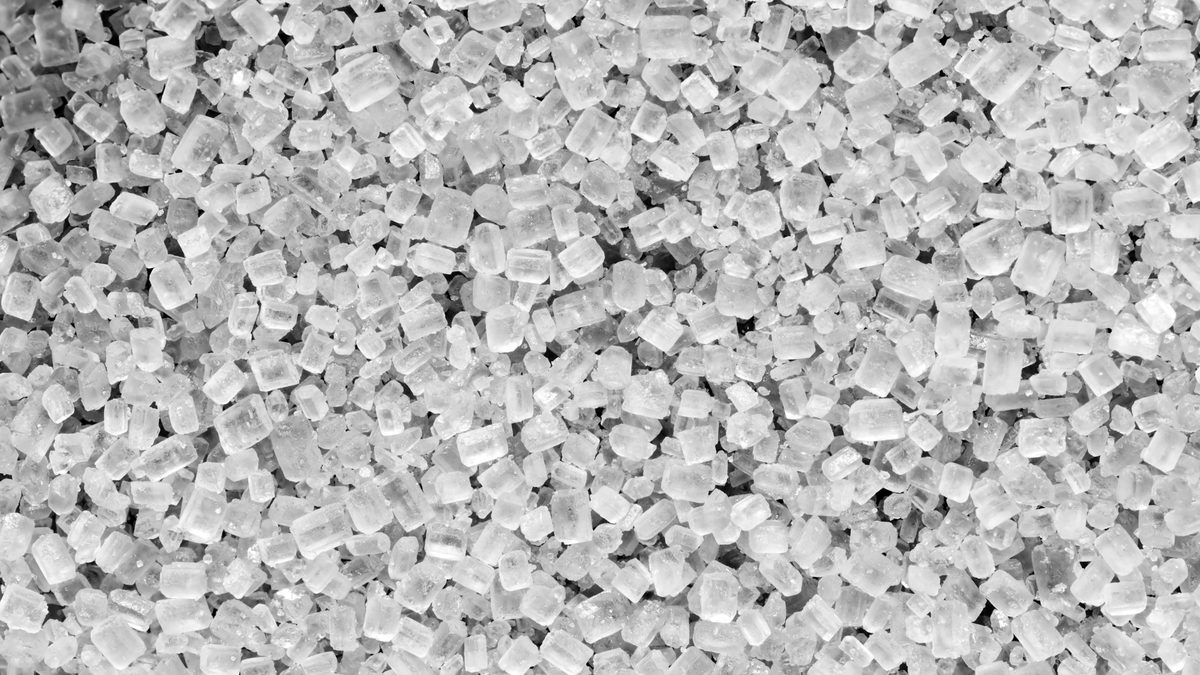
Sodium Chloride Grades: Technical, Food and Pharmaceutical Salt
Sodium chloride grades separate salt by purity, contaminant limits and the rules that apply to each end use.
The molecule is always NaCl. What changes is what else is present, how it is controlled and how it is documented.
This guide explains the three main grades, the standards behind them and how production method shapes them.
We write as a producer of lake salt and rock salt in Türkiye, with our own laboratory and quality systems.
Sodium chloride is sold in three main grades. Technical or industrial grade serves chemicals, water treatment and de-icing under process or application standards. Food grade meets food law, with the Codex standard setting at least 97% NaCl on a dry basis. Pharmaceutical grade follows Ph. Eur. or USP monographs, with USP requiring 99.0–100.5% NaCl on the dried basis.
What is sodium chloride?
Sodium chloride (NaCl) is an ionic compound of sodium and chloride. In nature it forms the mineral halite.
Its molar mass is 58.44 g/mol. By mass, it is about 39.3% sodium and 60.7% chloride.
Its CAS number is 7647-14-5, the identifier you will see on specifications and safety data sheets.
It crystallises in cubes, melts at about 801 °C and dissolves readily in water.
About 36 g dissolves in 100 g of water at 25 °C, according to PubChem data from the US National Library of Medicine.
That solubility is why salt can be dissolved into brine, purified and recrystallised to a higher grade.
Commercial salt comes from three sources: the sea or salt lakes, underground rock salt deposits and natural brine.
Our salt comes from two of them: solar lake salt from Lake Tuz (Tuz Gölü) and rock salt from Kırşehir Mucur.
Why salt is sold in grades
The same NaCl can carry very different companions.
Typical ones are calcium and magnesium salts, sulphates, insoluble matter and trace metals.
Each end use tolerates a different mix. A grade bundles the limits, controls and documents for that use.
A grade has four parts, and purity is only one of them:
- Composition. Minimum NaCl content and maximum levels of named impurities and contaminants.
- Physical form. Grain size, moisture and flow, set by how the salt is produced, dried and screened.
- Additives. Anti-caking agents, iodine compounds or other carried substances, where the rules allow them.
- Controls and documents. The quality system, testing and paperwork that show each lot meets the grade.
Higher grades cost more, because each step adds processing, testing or regulatory work.
Buying above the grade your process needs wastes money. Buying below it moves cost into your plant.
The grade also decides which law applies. Food and medicines are regulated products; most industrial uses are not.
Grade names also vary by market: technical, industrial or commercial; food or culinary; pharmaceutical or USP grade.
Check the standard behind the name, not the name itself. Two suppliers can use one label for different products.
Technical and industrial grade
Technical or industrial grade is salt for processes where it is neither eaten nor used as a medicine.
No single standard defines it. The application sets the rules, through a sector standard or a plant specification.
- Chlor-alkali and chemicals: plant purchase specifications focus on calcium, magnesium, sulphate and trace metals.
- Water softening: EN 973 covers sodium chloride used to regenerate ion exchangers in drinking water treatment.
- De-icing: EN 16811-1 sets requirements for sodium chloride spread on roads in winter, as crystals or brine.
- Textiles and leather: dye houses and tanneries set their own limits for iron, hardness, insolubles and grain size.
Within technical grade, processing depth still varies: raw, washed, double-washed or refined salt.
A technical-grade specification usually lists NaCl content, moisture, insoluble matter, calcium, magnesium and sulphate.
ISO test methods exist for these, such as ISO 2479 for insoluble matter and ISO 2482 for calcium and magnesium.
Grain size completes the picture, because it decides how the salt feeds, dissolves and stores.
Our industrial salt buyer’s guide explains how to specify and compare these.
For softeners, our water softening and treatment salt comes as tablets and granules.
Technical grade is not a lower-quality label.
Refined salt sold for industry can reach NaCl levels as high as food-grade salt.
The difference is the rulebook: food and pharmaceutical grades add legal controls on contaminants and production.
Technical-grade salt should therefore not go into food, even when its NaCl figure looks high enough.
Food grade
Food-grade salt is salt used as a food ingredient, sold to consumers or to food manufacturers.
The international reference is the Codex Standard for Food Grade Salt (CXS 150-1985).
It requires at least 97% NaCl on a dry matter basis, excluding additives, and caps copper at 2 mg/kg.
Other contaminants must meet the Codex general standard for contaminants in food and feed (CXS 193-1995).
Dry basis means the figure is calculated after removing moisture from the result.
A salt with 3% moisture and 99% NaCl on a dry basis contains about 96% NaCl as delivered.
The standard covers salt from the sea, from rock salt deposits and from natural brine.
It does not cover salt produced as a by-product of chemical industries.
Food-grade salt may contain permitted anti-caking agents and, where iodised, sodium or potassium iodide or iodate.
Iodisation levels are set by national health authorities, as the Codex text states.
For bulk food salt, Codex requires the product name, lot identification and producer or packer on each container.
Salt that carries additives, such as nitrite curing salt, must itself be food grade under Codex.
In export markets, national and EU food law and hygiene rules apply on top of Codex.
Food manufacturers also assess the supplier’s food safety system, such as ISO 22000 or HACCP.
Mutlucan holds ISO 22000 certification.
Current copies are on our certificates page.
For bakery, canning and ready meals, our food industry salt is fine-grained and comes in big bags or packs.
Our guide to food grade salt specifications covers limits, documents and audits in depth.
Pharmaceutical grade: an overview of Ph. Eur. and USP monographs
Pharmaceutical-grade sodium chloride is defined by pharmacopoeia monographs, not by a supplier’s label.
Search terms such as medical salt, salt medical or salts medical usually point to this grade.
In Europe, the reference is the European Pharmacopoeia monograph Sodium chloride (0193), published by the EDQM.
The EDQM knowledge database lists the monograph and its current status.
In the United States, the reference is the USP monograph for sodium chloride.
USP defines content as 99.0–100.5% NaCl, calculated on the dried basis.
The European, Japanese and US texts for sodium chloride are harmonised through the Pharmacopoeial Discussion Group.
Beyond content, the monographs include identity tests and limits for specific impurities.
Monographs change over time. The EDQM database shows revision work on metal tests, in line with ICH Q3D.
ICH Q3D is the international guideline on elemental impurities in medicines. Always check the current edition.
Note the upper limit above 100%: it reflects assay tolerance, not salt purer than pure.
Composition alone does not make salt pharmaceutical grade.
Medicine makers also qualify their suppliers under good manufacturing practice (GMP) requirements.
In Europe, a Certificate of Suitability (CEP) from the EDQM can show that a substance meets the Ph. Eur. monograph.
We do not describe any Mutlucan product here as pharmaceutical grade.
Pharmaceutical buyers should request monograph compliance, GMP and CEP evidence directly from any supplier.
For background on purity, see our article What Is High-Purity Salt?
Comparison table: sodium chloride grades by purity, typical uses and reference standards
The table sums up the main sodium chloride grades. Purity figures appear only where a source states them.
| Grade | Purity reference | Typical uses | Reference standards |
|---|---|---|---|
| Technical: raw salt | Natural level; rock salt typically 93–99% NaCl, dry basis (JRC, 2014) | De-icing, feedstock for refining, brine plants with full treatment | Plant specification; EN 16811-1 for roads |
| Technical: washed and double-washed | Higher than raw; stated per lot in the certificate of analysis | Leather, textiles, chemicals | Plant specification |
| Technical: refined (vacuum) | Vacuum salt typically 99.95% NaCl, dry basis (JRC, 2014) | Chlor-alkali membrane cells, softener tablets, chemicals | Plant specification; EN 973 for softeners |
| Food grade | At least 97% NaCl, dry basis, excluding additives | Table salt, food manufacturing, carrier for iodine or nitrite | Codex CXS 150-1985; national food law |
| Pharmaceutical grade | 99.0–100.5% NaCl, dried basis (USP) | Active substance or excipient in medicines | Ph. Eur. 0193; USP; GMP; CEP where required |
The JRC figures come from the EU reference document on chlor-alkali production.
They are literature values from Kirk-Othmer (2002), not the specification of any producer.
Two grades can share a purity figure and still differ. The documents and controls behind them are part of the grade.
Read the table from right to left: start with the standard your use requires, then look for salt that meets it.
How production method affects grade: solar, rock and vacuum salt
Production method sets the starting point for every grade. Each route leaves a different impurity profile.
Solar salt
Solar salt crystallises as the sun and wind evaporate seawater or lake brine in shallow ponds.
At Lake Tuz, we pump lake water into evaporation ponds. A salt layer of 8–10 cm forms on the pond floor.
After harvest, the salt is stockpiled and washed. Washing removes much of the insoluble matter and surface impurities.
Washed solar salt typically reaches about 99% NaCl, dry basis, in the JRC’s literature values (2014).
Our double-washed salt goes through two washing stages. It is our highest-purity washed grade.
Our guide to solar salt explains the evaporation process step by step.
Rock salt
Rock salt is mined from underground deposits of halite, left behind by ancient seas.
Its NaCl content depends on the deposit. The JRC’s typical range is 93–99% on a dry basis.
Rock salt tends to carry more calcium sulphate and relatively less magnesium than solar salt.
Crushed and screened, it suits de-icing and many technical uses. Dissolved, it can feed a vacuum salt plant.
We mine rock salt at Kırşehir Mucur, where our refining plants also operate.
Each year we produce over 1.5 million tonnes of raw lake salt and over 500,000 tonnes of raw rock salt.
Vacuum salt
Vacuum salt is made by dissolving salt, purifying the brine and recrystallising it in vacuum evaporators.
Chemical treatment removes most impurities from the brine before crystallisation, the JRC notes.
Its typical NaCl content is 99.95% on a dry basis, with calcium and magnesium at ppm levels.
Dried vacuum salt is known as PDV (pure dried vacuum) salt.
Our group brands Parla and Ahu produce vacuum-refined salt at Kırşehir Mucur with a stated purity of 99.9%.
Read more in our guide to PDV salt.
Production route sets the baseline. Washing, refining, testing and documentation then set the grade.
FAQ
What is the purest form of sodium chloride?
Laboratory reagent grades and pharmacopoeial sodium chloride carry the tightest limits; USP, for example, requires 99.0–100.5% NaCl on the dried basis. Among bulk salts, vacuum-crystallised salt has the highest typical NaCl content, around 99.95% on a dry basis in the JRC’s literature values. No commercial product is literally pure salt: every grade states its limits.
What is pharmaceutical grade salt?
Pharmaceutical grade salt is sodium chloride that meets a pharmacopoeia monograph, such as Ph. Eur. monograph 0193 or the USP monograph, and is made under the quality controls medicine makers require. Purity is only one part: identity tests, impurity limits, GMP-based supplier qualification and, in Europe, a CEP or equivalent documentation complete the picture.
Which grade of salt is used in water softeners?
Water softeners use high-purity sodium chloride, usually as compressed tablets or granules, to regenerate their ion-exchange resin. In Europe, salt for softeners that treat drinking water is covered by EN 973. Low insoluble matter matters, because residues collect in the brine tank. In US usage, tablets are often called pellets and granular salt is called crystals.
Is table salt pure sodium chloride?
Not entirely. The Codex standard requires at least 97% NaCl on a dry basis, excluding additives, so the rest can be natural minerals such as calcium and magnesium salts. Table salt may also contain permitted anti-caking agents and, if iodised, an iodide or iodate. Refined table salt made from vacuum salt has a very high NaCl content, but it is still specified to limits.
Find the right grade for your application
Tell us your application and the standard you work to.
We will match it to a grade from our industrial salt or food salt ranges.
Ask for the specification sheet and a recent certificate of analysis before you order.

