

What Is Solar Salt? How Solar Evaporation Produces Salt
Solar salt is sodium chloride made by letting sun and wind evaporate seawater or lake brine in shallow ponds.
No fuel boils the water. The climate does the work, while the producer steers the brine from pond to pond.
The term also has a second meaning in the energy sector. We separate the two, then follow the salt from brine to buyer.
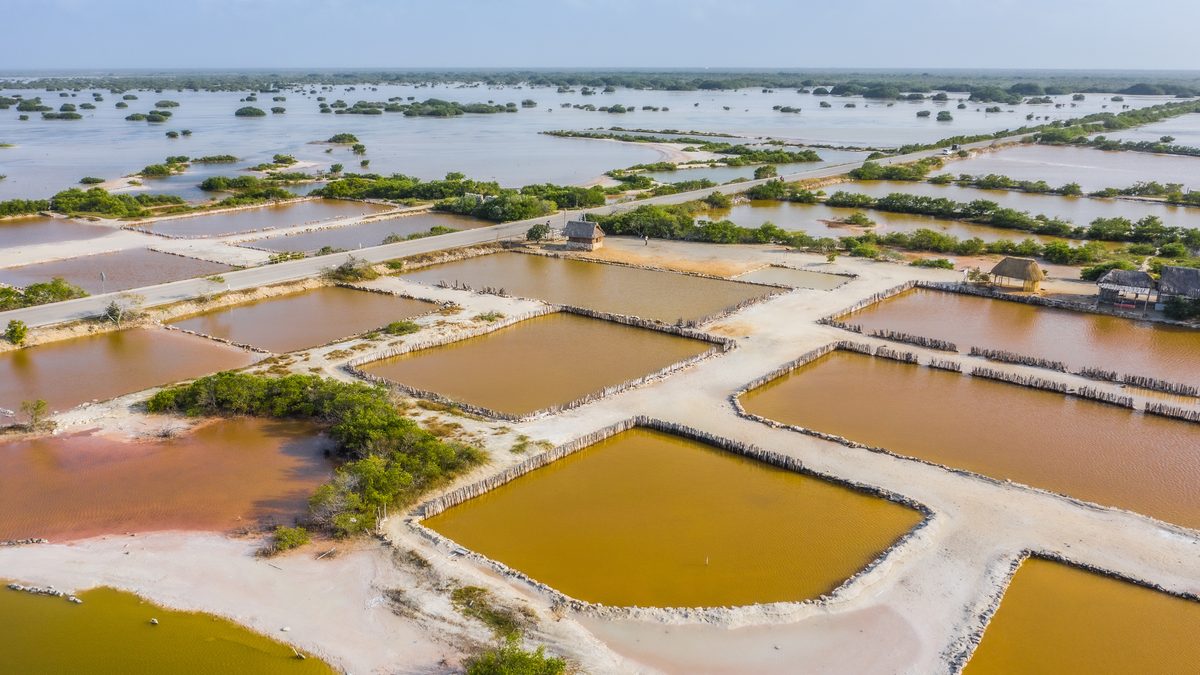
Solar salt is sodium chloride produced by solar evaporation: seawater or natural brine from a salt lake is fed into shallow ponds, where sun and wind evaporate the water until salt crystallises. The salt is then harvested, stockpiled and usually washed, dried and screened for water softening, de-icing, industrial processes and, after further processing, food.
What is solar salt?
Solar salt is defined by its method, not its source. Any salt crystallised from brine by sun and wind qualifies.
An EU expert report on salt production (EGTOP, 2021) uses the same idea.
It defines solar evaporation as the concentration and crystallisation of saline waters by sun and wind.
The brine can be seawater, a salt lake, a natural brine spring or dissolved rock salt.
Salt lakes are a major source worldwide, because their brine is already stronger than seawater.
In Europe, this method supplies a smaller share. EUSalt puts it at 10% of European salt output.
Most of that comes from France, Greece, Italy and Spain, where dry summers favour evaporation.
Producers often speak of solar salts in the plural: raw, washed, dried and screened grades from the same ponds.
Solar salt vs “solar salt” in concentrated solar power
Search for solar salt and you will also find a molten salt used in solar power plants. It is a different product.
In concentrated solar power (CSP), “solar salt” is a nitrate blend: 60% sodium nitrate and 40% potassium nitrate.
Sandia National Laboratories, a US research laboratory, tests this blend at 300 to 585 °C.
In a CSP tower, mirrors focus sunlight to heat the molten salt. Tanks store that heat for power generation later.
| Point | Solar salt (evaporated) | “Solar salt” in CSP plants |
|---|---|---|
| Chemistry | Sodium chloride (NaCl) | Sodium nitrate and potassium nitrate, 60/40 by weight |
| How it is made | Sun and wind evaporate brine in open ponds | Nitrate salts are blended and melted for use in the plant |
| Role of the sun | Evaporates water from brine | Heats the molten salt |
| Main uses | Water softening, de-icing, industry, food after processing | Heat transfer and thermal energy storage |
| Typical buyers | Water treatment, road authorities, chemical and food industry | Power plant developers and operators |
The rest of this article covers the first meaning. Mutlucan Tuz produces sodium chloride, not nitrate salts.
How solar evaporation works: ponds, crystallisation, harvest
Producing salt by solar evaporation is close to farming. It follows the weather and a seasonal work calendar.
- Intake. Seawater or lake brine is pumped, or fed by gravity, into a chain of shallow ponds with a sealed floor.
- Concentration. In the evaporating ponds, which cover most of a salt works, the brine strengthens towards saturation. Calcium carbonate and gypsum settle out first.
- Crystallisation. Saturated brine moves into crystallisers, where sodium chloride builds up as a layer on the pond floor.
- Harvest. Surplus brine is drained and machines lift the salt layer. In large salt works this usually happens once, at the end of summer.
- Stockpiling. The salt rests in open piles, where it drains naturally and loses moisture and some soluble impurities.
- Processing. Depending on the end use, the salt is washed, centrifuged, dried, crushed and screened.
Weather sets the pace. Evaporation must outrun rainfall, so wind, temperature, humidity and sunshine all count.
Producing sea salt follows the same steps. Seawater starts at about 3.5% salinity, so concentration takes longer.
Lake brine is already strong. It needs fewer concentration stages before salt starts to crystallise.
Lake Tuz (Tuz Gölü): a solar salt source in Türkiye
Lake Tuz (Tuz Gölü) lies in central Anatolia, where Ankara, Konya and Aksaray provinces meet.
It is Türkiye’s second-largest lake and one of the saltiest lakes in the world, covering about 1,665 km².
The lake is shallow, about 1.5 m deep on average. By the end of summer, its salt crust is thicker than 30 cm.
It has been a Special Environmental Protection Area since 2000 and is on UNESCO’s World Heritage Tentative List.
It is also a Class A wetland and a breeding ground for flamingos.
Our Kayacık salt works at Şereflikoçhisar, Ankara, has produced lake salt here since 2006.
We leave the lake’s natural salt crust untouched. Production runs in purpose-built ponds covering 10.7 million m².
Pumps lift lake water into the evaporation ponds. Sun and wind leave an 8–10 cm salt layer on each pond floor.
Special machines harvest the layer and carry it to stockpiles. The salt is then washed and sent on to our plant.
There it is ground, screened, iodised where required and packed.
Each stage is shown in how salt is obtained from Lake Tuz.
The process yields over 1.5 million tonnes of raw lake salt a year, supplied as raw lake salt or processed grades.
Importing? Our guide to sourcing salt from Türkiye covers grades, documents and shipping.
Solar salt vs rock salt vs vacuum salt
All three are sodium chloride. They differ in source, energy use and the secondary minerals they carry.
| Point | Solar salt | Rock salt | Vacuum salt |
|---|---|---|---|
| Source | Seawater or salt lake brine | Underground halite deposits | Brine made from rock salt |
| Process | Evaporation by sun and wind in ponds | Mining, crushing and screening | Brine purification, vacuum evaporation, drying |
| Energy use | Low; mainly sun and wind | Low | Several times higher than the other two |
| Typical secondary components | Calcium and magnesium salts, some insolubles and moisture | Anhydrite, clay and other insolubles | Traces only |
| Grain | Coarse crystals, crushed and screened as needed | Crushed to size | Fine and uniform |
| Typical uses | Water softening, de-icing, industry, food after processing | De-icing, chemical industry | Food, softener tablets, specialised uses |
The energy and composition rows follow the EU expert report cited above (EGTOP, 2021).
For winter roads, see our deicing rock salt vs solar lake salt comparison.
For the geology, read what lake salt is and how it differs from rock salt.
Uses of solar salt: water softening, de-icing, industry and food (after processing)
Raw salt is rarely used straight from the pond. Washing, drying and screening match it to each use.
- Water softening: washed salt from the ponds regenerates the ion-exchange resin in softeners. In the US it is sold as “solar salt crystals”; UK buyers usually say granular salt. See our water softening salt.
- De-icing: coarse grades melt ice on roads, pavements and industrial sites, supplied in bulk, big bags or sacks. See our guide to choosing salt for deicing.
- Industry: chemical production, textile dyeing, leather processing and other process uses that need sodium chloride.
- Food: after washing, drying, screening and, where required, iodisation, it becomes food salt.
Food salt must then meet food rules. The Codex Alimentarius standard CXS 150-1985 sets a floor.
That floor is 97% NaCl on a dry matter basis, excluding additives.
FAQ
Is solar salt the same as sea salt?
Not always. Sea salt names the source, seawater; solar salt names the method, evaporation by sun and wind. Solar-evaporated seawater is both sea salt and solar salt. Salt from a salt lake such as Lake Tuz is solar salt but not sea salt, and some sea salt is made in heated pans rather than by the sun.
Can solar salt be used in water softeners?
Yes. Washed, evaporated lake or sea salt is widely used to regenerate softener resin, usually as coarse granules, sold as crystals in the US. Check the softener maker’s guidance, as some units are designed for tablets and salt with more insolubles can leave residue in the brine tank. Our water softening salt comes in tablet and granular form.
How long does solar evaporation take?
It depends on climate, brine strength and pond design. In Europe’s large salt works, salt builds up in the crystallisers over several months, and the mechanical harvest normally comes once, at the end of summer; the EU expert report places most harvesting between June and October. Strong lake brine needs fewer concentration stages than seawater.
How pure is solar salt?
It depends on the source and on processing. Unwashed salt from the ponds carries some moisture, insolubles and calcium and magnesium salts; washing and drying remove much of these. Ask for a certificate of analysis showing NaCl on a dry basis, insolubles and moisture. For food use, the Codex standard sets a minimum of 97% NaCl on a dry basis.
Source solar lake salt from Lake Tuz
Tell us your application and grain size, and we will send specifications for our lake salt grades. Contact our team.

