

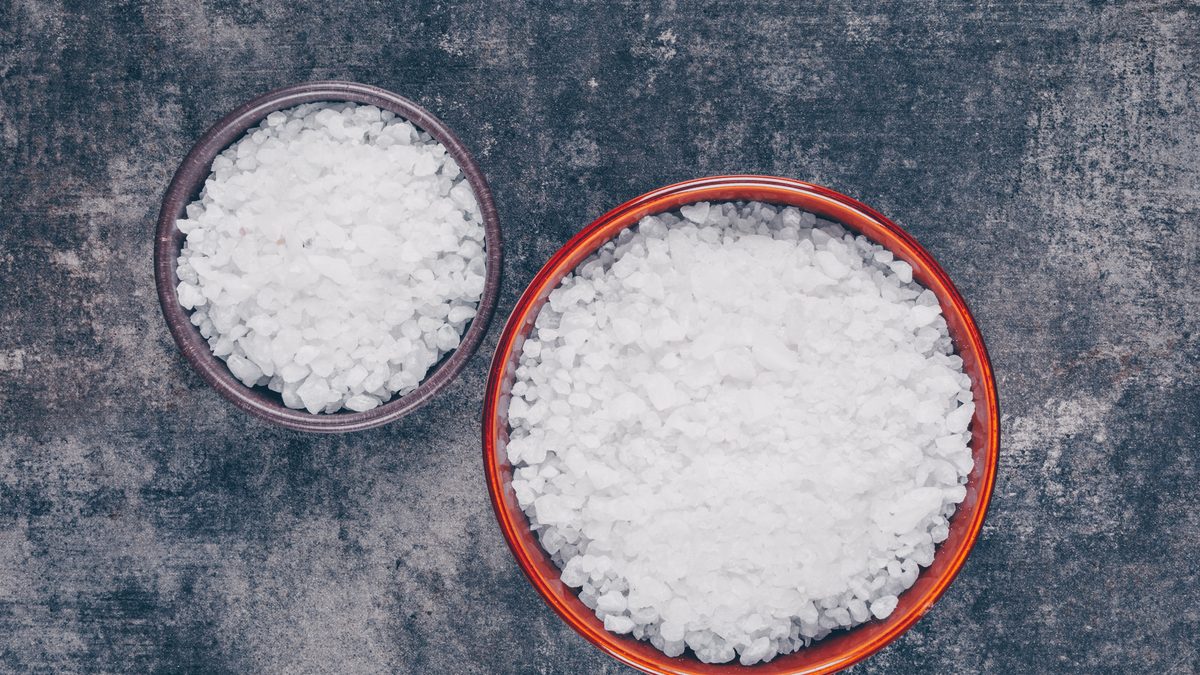
Fine Salt vs Coarse Salt: Grain Sizes for Food and Industry
Fine salt and coarse salt are the same sodium chloride; what separates them is grain size.
Grain size changes how salt dissolves, flows, sticks and doses, so it belongs in every specification.
This guide explains how salt grain size is measured and which grades suit food production and industry.
Fine salt has small grains that dissolve and disperse quickly, which suits doughs, dry blends and table use. Coarse salt has larger crystals that dissolve more slowly, which suits brines, pickling and grinders. Under the Turkish Food Codex, table salt passes a 1 mm sieve, while coarse brine salt is mostly 2–6 mm.
What is fine salt?
Fine salt is salt milled or crystallised to small, even grains.
Table salt, most food industry salt and powder salt are all fine grades.
Small grains dissolve quickly and spread evenly through flour, spices and other dry ingredients.
The Turkish Food Codex Salt Communiqué gives a clear benchmark for table salt.
All of it must pass a sieve with 1000 µm openings, and no more than 20% may pass a 210 µm sieve.
The second limit caps the share of very fine particles, so the salt stays even and free-flowing.
Our table salt is a fine grade, supplied iodised or non-iodised.
On spec sheets the same product may be listed as “salt, fine” or “fine salt”. The sieve range behind it matters.
Sea salt fine grades follow the same logic; only the source differs.
Our solar salt comes from Lake Tuz (Tuz Gölü) in central Türkiye, not from the sea.
What is coarse salt?
Coarse salt has larger crystals that are left whole or only lightly crushed.
Its grains dissolve more slowly and are easy to see and feel.
The Turkish Food Codex defines two coarse grades by sieve range.
Coarse brine salt passes a sieve of at least 6000 µm, with no more than 10% passing 2000 µm.
Grinder salt passes a sieve of at least 4000 µm, with no more than 10% passing 1000 µm.
Our coarse brine salt is used for pickles, cheese, olives and tomato paste.
It is also used to brine meat and fish, where its controlled dissolution helps.
Our grinder table salt is coarse crystal salt, sold in a glass jar with a built-in grinder.
How salt grain size is measured: sieve analysis and size ranges
Salt grain size is measured by sieve analysis, a simple test with a stack of sieves.
- Take a representative sample from the lot.
- Place it on a stack of test sieves, with the coarsest sieve at the top.
- Shake the stack for a fixed time.
- Weigh what each sieve retains and report it as % retained or % passing.
Test sieves are specified in ISO 3310-1, and the sieving method in ISO 2591-1.
Specifications give the result as a range, for example “100% below 1 mm, max. 20% below 0.21 mm”.
A single average hides the tails. Two salts with the same average can dose and dissolve differently.
Openings are given in micrometres (µm) or millimetres; 1000 µm equals 1 mm.
US specifications often use mesh numbers instead.
The mesh number roughly counts openings per inch, so a higher number means a finer sieve.
When comparing offers, convert mesh to opening size using the sieve standard named in each spec.
The Codex salt standard (CXS 150-1985) sets no grain size, so the buyer’s spec defines it.
Grain size by application
The table uses the Turkish Food Codex ranges where they exist. Other grades are agreed with the customer.
| Application | Typical grade | Grain size reference |
|---|---|---|
| Table salt (retail) | Fine | 100% below 1000 µm; max. 20% below 210 µm (Turkish Food Codex) |
| Bakery, ready meals, sauces | Fine food industry salt | Agreed per process; fine and free-flowing |
| Snack seasoning, spice blends | Powder salt | Very fine; agreed with the customer |
| Meat products and curing blends | Fine salt or fine nitrite curing salt | Matched to the other ingredients to limit separation |
| Grinding at the table | Coarse crystal | 100% below 4000 µm; max. 10% below 1000 µm (Turkish Food Codex) |
| Pickles, olives, cheese brines | Coarse brine salt | 100% below 6000 µm; max. 10% below 2000 µm (Turkish Food Codex) |
| Water softening | Granular salt or tablets | Set by the softener design |
| Industrial dissolving | Granular to coarse | Set by the dissolver and handling system |
Why grain size matters in food production: dissolution, adhesion, dosing
Grain size is a process parameter, not a cosmetic one. Three effects matter on the line.
Dissolution
Smaller grains have more surface per gram, so they dissolve faster.
In low-water doughs, fine salt dissolves during mixing; coarse grains can stay whole.
In brine making, all the salt dissolves, so grain size affects dissolving time and handling, not taste.
Adhesion
On snacks, fine or powder salt clings better to oiled or moist surfaces and gives even coverage.
Coarse crystals are chosen when a visible crystal or a crunch on the surface is the goal.
Dosing
A change in grain size changes bulk density.
A volumetric doser then delivers a different weight of salt.
Even grain size also keeps blends from separating in transit and in hoppers.
Damp fine salt cakes more easily and stops flowing, so moisture belongs in the spec too.
Grain size is one line of a full specification; purity, moisture and contaminants complete it.
See our guide to food grade salt specifications for those limits.
Grain size in industrial and water treatment salt
Industrial buyers set grain size for handling as much as for chemistry.
Dissolvers and brine saturators need grains that do not bridge or pack.
That is why granular or coarse salt is common in industrial dissolving.
Our group’s refined industrial salt has low moisture and a homogeneous grain.
Water treatment salt comes as granular salt or compressed tablets, and we supply both forms.
US retail often calls tablets “pellets” and granular salt “crystals”; UK and EU buyers say tablets and granular.
To choose between them for softeners, see granular salt vs tablet salt.
De-icing salt is graded under its own European standard, EN 16811-1, and is outside the scope of this guide.
At our plant, washed lake salt is milled and sieved to the grain size the customer specifies.
FAQ
Is fine salt saltier than coarse salt by volume?
By weight, no: a gram of fine salt and a gram of coarse salt contain the same sodium chloride. By volume, yes: fine grains pack more tightly, so a spoonful of fine salt holds more salt than a spoonful of coarse salt. Recipes and production dosing should therefore use weight, not volume.
Can coarse salt replace fine salt in food production?
Sometimes, but not one-for-one. Coarse salt dissolves more slowly, may not disperse evenly in doughs or dry blends, and changes the weight delivered by volumetric dosers. If you switch, dose by weight and test dissolution in your own process, or specify a fine grade instead.
Which grain size is used for brining?
Coarse brine salt is the usual choice for pickles, olives, cheese brines and meat or fish brining. Under the Turkish Food Codex, coarse brine salt passes a sieve of at least 6000 µm, with no more than 10% passing 2000 µm. Because the salt fully dissolves, low insoluble matter matters as much as grain size.
What is powder salt?
Powder salt is very finely milled salt. It spreads evenly and clings well to surfaces, so it is used for snack seasoning and spice blends. Our group’s refined powder salt, sold under the Parla and Ahu brands, serves these uses. Ask the supplier for the sieve range and whether an anti-caking agent is added.
Find the right grain size
Send us your process and target sieve range, and we will match it to our fine, coarse or granular grades.
For bakery, ready meals and dry blends, start with our food industry salt.

