

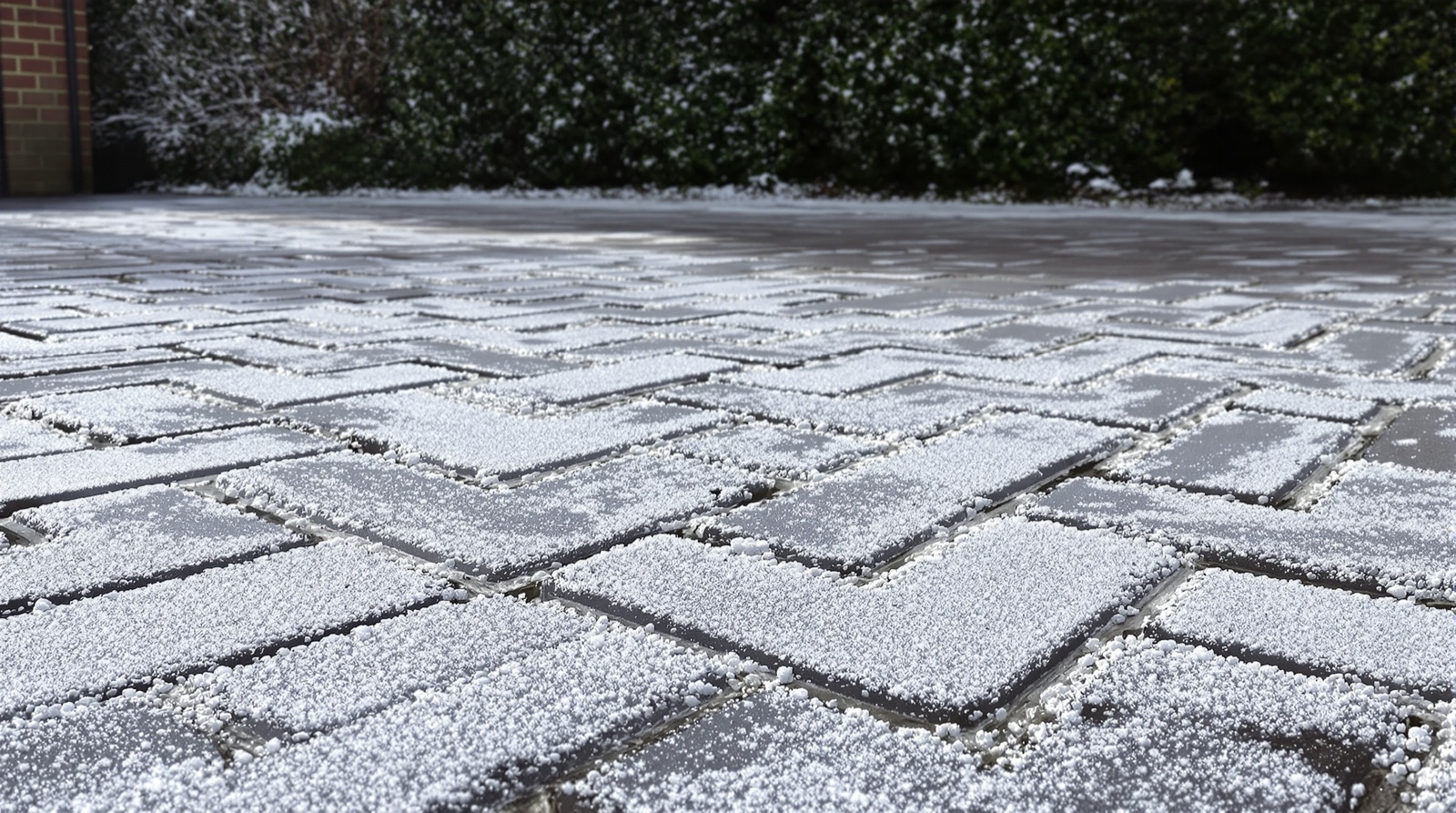
Salt for Driveways: How Much to Use and When to Spread
Salt for driveways works by forming brine that melts ice and stops new ice bonding to the surface. Rock salt and lake salt both work well near freezing. Spread lightly before frost, more heavily after snow, and sweep away residue later. Correct rates protect paving, plants and pets.
Salt for driveways is a small-area version of the work highway teams do on roads. Facility managers, housing providers and car park operators face the same questions each winter. How much salt is enough? When should it go down? Will it harm concrete or block paving? This guide answers those questions in plain terms. It also covers bagged supply for distributors and sites.
Does salt work on driveways?
Rock salt and lake salt work on driveways in the same way as on roads. Sodium chloride dissolves in moisture on the surface and forms brine. Brine has a lower freezing point than water, so ice melts and new ice struggles to bond. Salt is most effective close to freezing. Its effect weakens as temperatures fall towards minus 7 to minus 10 °C, where melting slows down markedly.
Driveways bring a few extra factors. They are often shaded, so frost lingers longer than on open roads. Traffic is light, so salt is not churned into the ice. Slopes and steps carry a higher slip risk. Applying salt for driveways at the right time matters more than applying a large amount.
- Salt needs some moisture to start working.
- Light traffic means salt may need sweeping into ice.
- Shade and slopes need closer attention.
Which salt for driveways: rock salt or lake salt
Both rock salt and lake salt are suitable for driveways, paths and car parks. Rock salt for driveways is the most common choice in the UK. It is sold as brown rock salt, which contains clay or marl, or as white rock salt with fewer insolubles. Washed lake salt from sources such as Lake Tuz (Tuz Gölü) in Türkiye is white and leaves little visible residue. The right fit depends on the surface and how clean it must stay.
Brown grades add some grip but can leave muddy residue on light paving. White grades are often chosen for entrances, forecourts and block paving. Our comparison of deicing rock salt vs solar lake salt sets out the differences in detail. For a closer look at rock salt itself, see our raw rock salt product page.
- Brown rock salt: grip from fines; visible residue.
- White rock salt: cleaner finish; suits light paving.
- Washed lake salt: white crystals; low residue.
How much salt per square metre
How much salt per square metre to use depends on the conditions, not on a single fixed figure. Highway practice in the UK follows the National Winter Service Research Group (NWSRG). According to NWSRG guidance, spread rates are set by road surface temperature and the type of hazard. For small sites, the same logic applies. A light precautionary dose prevents frost. Heavier doses are kept for ice and snow.
As a general range, precautionary rates for frost are often in the region of 10–20 g per square metre. Ice and light snow need heavier rates, and deep snow should be cleared before salting. A level handful is roughly 15–20 g of salt. Always check the guidance for your site and adjust to local conditions.
| ConditionGeneral approach | |
|---|---|
| Frost forecast, dry surface | Light precautionary spread |
| Ice already formed | Moderate spread, repeat if needed |
| Light snow | Spread before and during snowfall |
| Deep snow | Clear first, then salt the remaining layer |
More salt does not mean faster melting once the surface is covered. Excess salt is simply washed away or tracked indoors.
When to spread: before frost or after snowfall
Timing is the most important factor when you spread salt for driveways. Precautionary salting, before frost or ice forms, uses less salt and gives better results. The salt dissolves into a thin brine that stops ice bonding. If you wait until ice forms, more salt is needed and it takes longer to work. Snow is handled most effectively by clearing first and then salting.
A simple routine works for most sites:
- Check the forecast each afternoon from November to March.
- Spread a light dose in the early evening if frost is likely.
- After snowfall, clear snow with a shovel or brush.
- Salt the cleared surface to stop refreezing.
- Re-check slopes, steps and shaded areas in the morning.
Avoid salting during heavy rain, which washes salt away. Early morning frost after a clear night is the most common risk.
Paths, steps and car parks: practical tips
Paths, steps and car parks each need a slightly different approach. Steps and ramps carry the highest slip risk, so treat them first. Paths need even coverage along their full width. Car parks need attention at entrances, pedestrian routes and payment points, where people walk most. Salt for car parks is usually spread by hand spreader or small vehicle-mounted spreader to keep coverage consistent.
Practical tips for site teams:
- Mark priority routes on a site plan.
- Keep salt bins close to steps, ramps and entrances.
- Use a push spreader for even coverage on large areas.
- Avoid piling salt in one spot, which wastes it.
- Record each treatment for your winter log.
Ice melt products other than sodium chloride exist, such as calcium or magnesium chloride. They work at lower temperatures but behave differently on surfaces. Sodium chloride remains the standard choice for most UK sites.
Protecting concrete, block paving, plants and pets
Correct use of salt for driveways limits side effects on surfaces, plants and animals. Good-quality concrete that has fully cured is generally resistant to normal salting. New concrete, laid within the last year, is more sensitive. Freeze-thaw cycles cause most surface damage, and salt can make those cycles more frequent. Block paving can show white or brown marks if residue is not swept away.
Simple steps reduce risk:
- Use the lowest effective rate and avoid heaps.
- Sweep up residue once the thaw sets in.
- Keep salt off lawns, flower beds and hedges.
- Choose white grades on light paving to reduce staining.
- Rinse pets' paws after walks on salted areas.
- Store salt bags where animals cannot reach them.
Salt is sodium chloride and should not be eaten by pets. Treat paths where animals walk with care and clean paws after use.
Buying bagged salt for the season
Bagged salt for the season is the usual format for driveways, paths and car parks. Small bags, commonly 20 kg to 25 kg, suit hand spreading and storage in bins. Bulk bags suit larger sites and distributors who refill bins across a portfolio. Bag weights are confirmed with our sales team for each order. Buying before November avoids shortages when a cold spell hits.
Store bagged salt indoors or under cover, on pallets, away from damp floors. Salt absorbs moisture and can cake if bags are damaged. Mutlucan Tuz supplies distributors and facility buyers, not individual retail customers. Our de-icing road salt is available in bags, big bags and bulk. Since 2006, we have shipped salt to more than 40 countries. For wider winter planning, read our de-icing salt guide.
FAQ
Facility managers and distributors often ask the same practical questions about salt for driveways. The answers below cover surface damage, how long salt lasts, table salt and pet safety. They are general guidance. Always follow site-specific risk assessments and the instructions on the bag for safe use.
Will salt damage my driveway?
Well-cured concrete and good block paving usually tolerate normal salting. New concrete is more sensitive, so use light rates and sweep away residue once ice has melted.
How long does salt last on a driveway?
Salt can keep working for several hours to a day in dry, cold weather. Rain, melting snow and traffic dilute it, so re-treat before the next frost.
Can table salt be used on a driveway?
Table salt will melt ice, but it is fine and dissolves very quickly. Coarser rock salt or lake salt lasts longer on the surface and is easier to spread evenly.
Is rock salt safe for pets?
Rock salt should not be eaten by pets and can irritate paws. Use light rates, keep bags out of reach and rinse paws after walks on salted surfaces.
Distributors and facility buyers can request a quote for bagged or bulk salt through the Mutlucan Tuz contact page.

Post a comment