

Deicing Rock Salt vs Solar Lake Salt for Winter Roads
Deicing rock salt and solar lake salt both melt ice in the same way, because both are sodium chloride. They differ in source, purity, colour, moisture and residue. Rock salt is mined and crushed. Lake salt is harvested after solar evaporation. The right choice depends on climate, storage and the surfaces you treat.
Deicing rock salt is the most familiar winter road material in the UK and much of Europe. Solar lake salt is a second, widely used option. Road authorities, contractors and distributors often ask which one to buy. Mutlucan Tuz produces both types in Türkiye, so we can compare them from the production side. This guide sets out the facts without favouring either source.
Two sources of de-icing salt
Winter maintenance teams in Europe and North America draw on two main natural sources of de-icing salt. The first is underground rock salt, mined from ancient evaporite deposits. The second is solar salt, produced when sunlight and wind evaporate brine in shallow pans. Both deliver sodium chloride, the compound that lowers the freezing point of water on a road surface. The practical differences come from geology and processing, not from the chemistry of melting.
Mutlucan Tuz has worked with both sources since 2006. Every year we produce more than 1.5 million tonnes of raw lake salt and more than 500,000 tonnes of raw rock salt. Our salt reaches more than 40 countries. That dual production gives buyers a direct view of how each material behaves in practice.
- Rock salt: mined underground, crushed and screened to a grading.
- Solar lake salt: harvested from evaporation pans, then washed or screened.
- Shared function: both form a brine that melts ice and stops it bonding.
What is deicing rock salt?
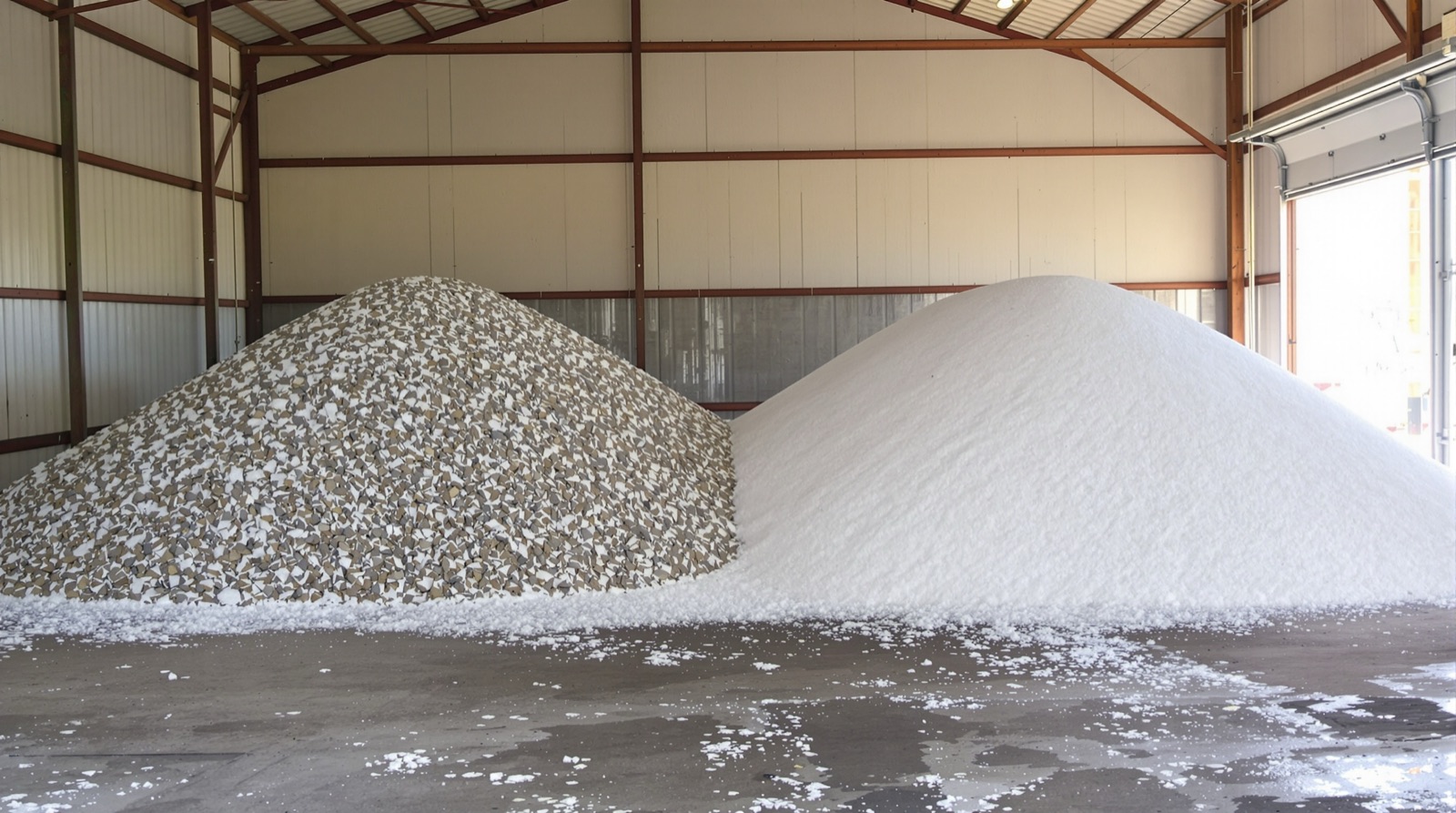
Deicing rock salt is crushed halite mined from underground deposits and screened to a grading suitable for spreading on roads. In the UK it is often called gritting salt. Natural rock salt carries some insoluble matter, such as clay or marl, from the surrounding rock. That fine material gives brown rock salt its colour and adds some grip on the road. Cleaner seams give a white rock salt with lower insoluble content.
Rock salt is usually supplied in a top-size grading such as 6 mm or 10 mm. The grading suits spreader settings used by highway authorities. Moisture is generally low, because the salt comes from dry underground deposits. Our raw rock salt is supplied crushed and screened, with values stated in the product analysis certificate.
Where rock salt is commonly used
- Motorways and trunk roads under precautionary salting.
- Car parks, industrial estates and service areas.
- Stockpiles where long storage periods are expected.
What is solar lake salt?
Solar lake salt is sodium chloride that crystallises when the sun and wind evaporate saline lake water in open pans. In Türkiye, the main source is Lake Tuz (Tuz Gölü) in Central Anatolia. Each summer the lake brine concentrates, and salt is harvested from the crust. The crystals are then washed, drained and screened. Our guide on what solar salt is explains the evaporation process in detail.
Solar lake salt is typically white or off-white. Its crystals are often more regular in shape than crushed rock salt. Because the salt comes from a wet environment, moisture is usually higher at the point of harvest and falls with drying and stockpiling. Mutlucan supplies raw lake salt for road, industrial and further processing uses.
Comparison table: purity, insolubles, moisture, grain size, colour, residue
Deicing rock salt and solar lake salt can be compared on six practical parameters. The table below gives general characteristics, not guaranteed values. Exact figures depend on the deposit, the processing and the lot. For any tender, buyers should rely on the analysis certificate of the specific product. According to EN 16811-1, the CEN standard for de-icing salt published in 2016, de-icing salt is specified by quality classes.
| ParameterDeicing rock saltSolar lake salt | ||
|---|---|---|
| Source | Underground mine | Evaporation pans at a saline lake |
| Sodium chloride content | Varies by seam; white grades are higher | Generally high after washing |
| Insolubles | Present in brown grades (clay, marl) | Generally low after washing |
| Moisture | Generally low | Higher at harvest; falls with drying |
| Grain size | Crushed and screened, angular | Regular crystals, screened |
| Colour | Brown, grey or white | White to off-white |
| Residue on surfaces | Visible fines in brown grades | Little visible residue |
For a deeper look at standard classes and tender wording, see our explainer on the EN 16811-1 de-icing salt standard.
Performance on roads and pavements
Melting performance on roads depends mainly on sodium chloride content, grain size and spread rate, not on whether the salt was mined or evaporated. Once salt dissolves into brine, both sources work in the same way. Brine lowers the freezing point of water and weakens the bond between ice and the surface. Sodium chloride is effective down to around minus 5 to minus 7 °C on most roads. Below that range, performance falls and other measures are often added.
Grain size matters for speed and persistence. Finer particles dissolve quickly and act fast. Coarser particles last longer and resist being blown off the carriageway by traffic. Insoluble fines in brown rock salt can add some short-term grip. They also leave material that must be swept later. Our de-icing salt guide covers spread rates and timing in more depth.
- Match grading to spreader calibration.
- Use pre-wetting where available to reduce bounce and scatter.
- Treat before frost forms where forecasts allow.
Storage behaviour and caking
Storage behaviour is a key selection factor, because winter salt may sit in a dome or barn for months before use. Salt is hygroscopic: it takes up moisture from humid air and releases it in dry weather. Repeated cycles can bind crystals into a crust, known as caking. Caking slows loading and can block spreaders. Both rock salt and lake salt can cake if stored badly.
Lake salt with higher moisture may need more attention in covered storage. Rock salt with high fines can also compact over time. Anti-caking agents are often added to road salt to keep it free-flowing. The type and dose are stated on the product data sheet. Good practice applies to both sources:
- Store under cover, on a sealed and drained base.
- Keep stockpiles in a cone shape to shed water.
- Rotate stock so older salt is used first.
- Check flow before the first cold spell of the season.
Choosing by climate and application
Choosing between deicing rock salt and solar lake salt starts with the climate and the surfaces you treat. In mild maritime winters with frequent frost near zero, either source performs well on roads. In colder inland and Nordic climates, buyers often focus on grading, moisture and storage life. For pedestrian zones, ramps and paved areas, low visible residue is often a priority. Supply security and logistics also shape the decision.
Many authorities use both sources across a network. They may keep brown rock salt for trunk roads and choose white rock salt or washed lake salt for urban areas. Mutlucan supplies road salt from both sources, so buyers can combine products under one supplier. Typical considerations include:
- Climate: typical minimum temperatures and frost frequency.
- Surfaces: carriageway, footway, car park or block paving.
- Storage: covered dome, open stockpile or bagged stock.
- Logistics: vessel loads, big bags or smaller bags.
- Specification: the quality class required in the tender.
For more on how lake salt is formed, read what lake salt is and how it differs from rock salt.
FAQ
Buyers comparing deicing rock salt with solar lake salt usually ask the same practical questions. The answers below cover performance, colour, suitability and residue. They give general guidance for road authorities, contractors and distributors. Specific values for a product always come from its analysis certificate and technical data sheet.
Does solar salt work for de-icing?
Yes. Solar salt is sodium chloride, so it melts ice in the same way as rock salt. Performance depends on purity, grain size and spread rate rather than on the source.
Why is some road salt brown?
Brown road salt is rock salt that contains insoluble material such as clay or marl from the surrounding rock. The fines colour the salt and can leave visible residue after melting.
Can lake salt be used on roads?
Yes. Lake salt is widely used for winter road maintenance. It is screened to a suitable grading and stored under cover like other de-icing salt.
Which salt leaves less residue on pavements?
Salt with low insoluble content leaves less visible residue. White rock salt and washed lake salt usually leave less than brown rock salt, which carries more fines.
To discuss gradings, quality classes and supply formats for the coming winter, contact our export team through the Mutlucan Tuz contact page.

