

Industrial Salt Buyer’s Guide: Grades, Packaging and Supply
This industrial salt buyer’s guide explains how to specify, compare and source salt in bulk for industrial processes.
Industrial salt looks like a commodity. Yet two lots sold under the same name can behave very differently in a plant.
The gap sits in the details: impurities, moisture, grain size, packaging and the paperwork behind each lot.
We write as a producer. Mutlucan Tuz has produced lake salt and rock salt in Türkiye since 2006.
An industrial salt buyer should check four things: the grade (raw, washed, double-washed or refined), the specification (NaCl content, moisture, insoluble matter, calcium and magnesium, grain size), the packaging and delivery format, and the documents behind each lot, above all a certificate of analysis. Supplier consistency and logistics complete the picture.
What counts as industrial salt?
Industrial salt is sodium chloride (NaCl) sold for processing, treatment or manufacturing rather than for the table.
It covers a wide range: raw rock salt for roads, washed lake salt for tanneries, refined salt for chemical plants.
What unites these uses is one buyer question: will this salt perform in my process without extra cost or downtime?
Chemically, every grade is the same compound. The differences lie in what else is present, and in what physical form.
Natural salt carries secondary minerals such as calcium sulphate, magnesium salts and insoluble clay or sand.
Processing removes part of these impurities. It also changes crystal size, moisture and the way the salt flows.
That is why a buyer cannot compare offers on price alone. A cheaper tonne can cost more once it reaches the process.
Insoluble matter becomes sludge that someone must remove. Excess moisture is water you pay to ship and store.
Calcium and magnesium turn into scale or consume treatment chemicals.
The wrong grain size blocks feeders, cakes in silos or dissolves too slowly.
Industrial salt is also a food-law question in some plants. Salt for food processing must meet food-grade rules.
For a wider view of end uses, see 7 industrial uses of salt you didn’t know.
Industrial salt grades: raw, washed, double-washed and refined
Most industrial salt suppliers group their range by processing depth. Each step lowers impurities and adds cost.
The practical rule is simple: buy the least processed grade that still keeps your process stable.
Raw salt
Raw salt is harvested or mined salt that has at most been crushed and screened. It keeps its natural impurities.
Our raw lake salt comes from solar evaporation ponds at Lake Tuz (Tuz Gölü), Ankara.
Raw rock salt comes from our mine at Kırşehir Mucur. Both feed further processing.
Raw rock salt also goes to road de-icing, chemicals, water conditioning and livestock salt licks.
Raw salt suits users who dissolve and treat the salt themselves, or where impurities do not affect the result.
Washed salt
Washed salt is crushed and then washed to remove clay, sand and other insoluble matter. Its NaCl content rises.
Washed salt serves food processing, leather, textiles and chemicals, in bulk or in bags.
The crystals keep their natural shape. Washing mainly targets insolubles and surface impurities, not dissolved minerals.
Double-washed salt
Double-washed salt passes through two washing stages after crushing. It is our highest-purity washed grade.
Buyers choose double-washed salt where low insoluble matter matters, such as sensitive food production.
Refined (vacuum) salt
Refined salt is made by dissolving salt, purifying the brine chemically and recrystallising it under vacuum.
The result is fine, uniform crystals with very high NaCl content. Dried vacuum salt is often called PDV salt. Our vacuum salt guide explains how it is produced and where it is used.
PDV stands for pure dried vacuum. Our group brands Parla and Ahu produce vacuum-refined rock salt at Kırşehir Mucur.
Refined salt costs more per tonne. It can still be cheaper overall when it cuts brine treatment or cleaning downtime.
Specifications to request: NaCl content, moisture, insolubles, calcium and magnesium, grain size
The specification is the core of any industrial salt buyer’s guide. A grade name alone is not a specification.
Ask every supplier for the same parameters, measured by stated methods.
- NaCl content. Usually stated as a percentage on a dry basis. It shows how much of the product is sodium chloride.
- Moisture. Reported as loss of mass on drying. Moisture adds weight you pay for and affects caking and flow.
- Insoluble matter. Clay, sand and other residues that do not dissolve. They form sludge in dissolvers and brine tanks.
- Calcium and magnesium. These cause hardness and scale. They matter most in brine electrolysis and water treatment.
- Grain size. Given as a sieve range in millimetres, ideally with the share passing each sieve.
Depending on the process, many buyers add sulphate, iron, heavy metals and anti-caking agents to the list.
Ask which test methods sit behind the numbers. ISO publishes a series of methods for sodium chloride for industrial use.
For example, ISO 2482 covers calcium and magnesium, ISO 2479 insoluble matter and ISO 2483 loss of mass at 110 °C.
Two suppliers can report different results for the same salt if they test by different methods. Agree the method first.
Then write the limits into the contract. State each parameter, its unit, its limit and the method used to test it.
Add the sampling point as well: at loading, at discharge or at your gate. Results can shift between these points.
Moisture is the usual example. Salt can pick up or lose water on the way, so agree where moisture is measured.
Typical values vary widely by source. The table shows literature values, not the specification of any supplier.
The EU reference document on chlor-alkali production (JRC, 2014) gives these typical compositions:
| Component (dry basis) | Rock salt | Washed solar salt | Vacuum salt |
|---|---|---|---|
| NaCl | 93–99% | 99% | 99.95% |
| Sulphate (SO4) | 0.2–1% | 0.2% | 0.04% |
| Calcium (Ca) | 0.05–0.4% | 0.04% | 0.0012% |
| Magnesium (Mg) | 0.01–0.1% | 0.01% | 0.0001% |
The JRC document takes these figures from Kirk-Othmer (2002). They show the order of magnitude, not a guarantee.
For our own grades, the certificate of analysis for each lot is the reference. Ask for a recent one before you order.
Our industrial salt product page lists NaCl content of up to 99.8%. The exact value depends on the grade.
Matching salt grade to application
Each process has its own weak point: sulphate in chlor-alkali, iron in dye houses, insolubles in dissolvers.
| Application | Typical grade | Parameters to watch | Reference |
|---|---|---|---|
| Chlor-alkali (brine electrolysis) | Washed solar salt, rock salt or vacuum salt, depending on the plant’s brine treatment | Calcium, magnesium, sulphate, insolubles, trace metals | Plant purchase specification; JRC BREF (2014) |
| Textiles (reactive and direct dyeing) | Washed, double-washed or refined salt | Iron, hardness (calcium, magnesium), insolubles | Dye house specification |
| Leather (hide curing and pickling) | Raw or washed crushed salt | Grain size, cleanliness, moisture | Tannery specification |
| Water treatment (softener regeneration) | High-purity salt as tablets or granules | Insolubles, NaCl content | EN 973 |
| De-icing (roads) | Rock salt, solar salt or vacuum salt | Grain size, moisture, NaCl content | EN 16811-1 |
| Food processing | Food-grade washed, double-washed or refined salt | NaCl content, contaminants, grain size | Codex CXS 150-1985 |
We compare three of these sectors in our guide to chlor-alkali, tanning and textile salt.
For drinking water softeners, EN 973 sets requirements for salt that regenerates ion exchangers. Commercial softeners often run on compressed salt tablets, covered in our 25 kg tablet guide.
Road de-icing salt is specified under EN 16811-1, which covers crystalline salt and brine.
Food processing falls under food law, whatever the plant calls the salt internally.
The Codex Standard for Food Grade Salt (CXS 150-1985) sets at least 97% NaCl on a dry basis.
That Codex figure excludes additives. National and EU food rules apply on top of it in the buyer’s market.
If you are unsure which grade fits, our overview of sodium chloride grades compares them.
Packaging and delivery: bulk vessel, big bags, bags
Packaging decides your unloading method, storage space and handling cost. Choose it together with the grade.
Bulk vessel
Bulk salt by sea suits large, regular volumes and buyers with covered storage close to a port or waterway.
Salt in bulk is loaded loose into the ship’s hold. Unit cost is low, but you need grab unloading and a dry store.
Salt absorbs moisture and can cake in the pile. Plan for roofed storage and first-in, first-out stock rotation.
Large bulk lots also need a sampling plan. Agree in advance where and how samples are taken during loading.
Keep different grades in separate bays. Mixed stockpiles are a common cause of off-specification deliveries.
Big bags
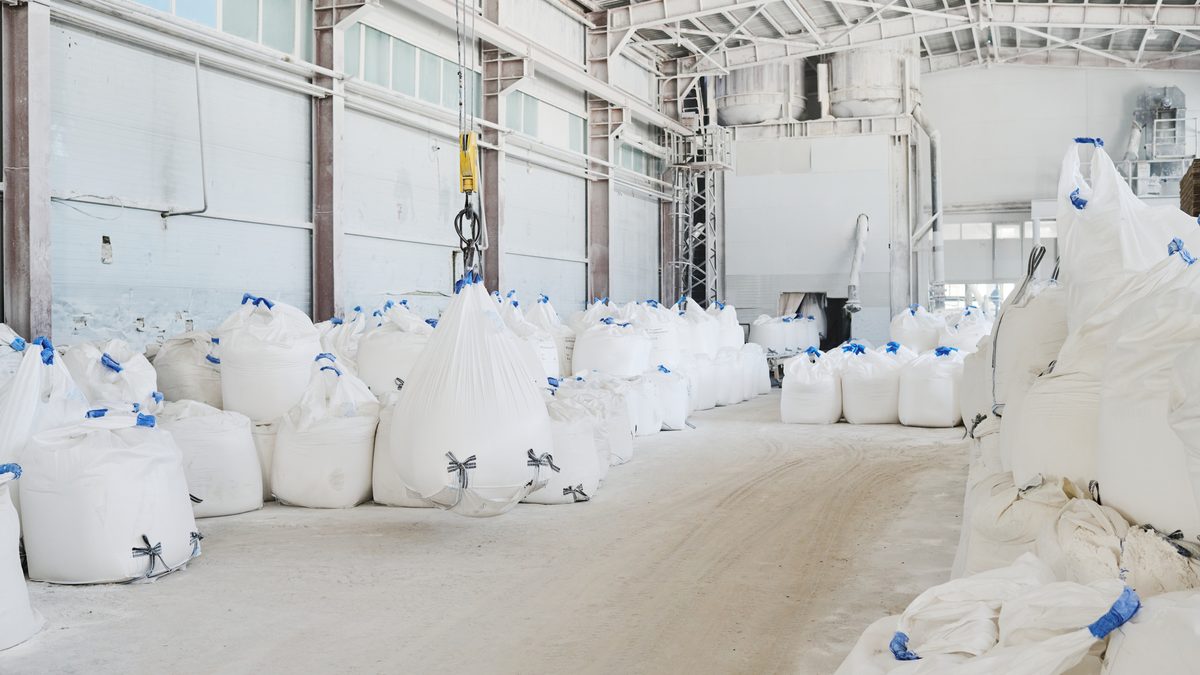
Big bags, or flexible intermediate bulk containers (FIBCs), move salt in sealed units by truck or container.
They suit mid-sized volumes and plants that dose salt from bag dischargers. Ask for bag size, liner and lifting loops.
Big bags keep each lot separate. That makes traceability and quarantine simpler if a result is out of specification.
Bags
Smaller bags suit manual dosing, lower volumes and sites without bulk handling equipment.
Ask about pallet pattern, stretch-wrapping and labelling, so the lot number stays visible on every unit.
Mutlucan supplies industrial grades in bulk, in big bags and in packaged form. The formats vary by product.
Documents to ask for: certificate of analysis, ISO certificates, safety data sheet
A capable supplier sends documents before the first shipment, not after a complaint.
- Certificate of analysis (CoA). Lot-specific results for the agreed parameters, with test methods and the laboratory named.
- Specification sheet. The guaranteed limits for each grade. Compare it with the CoA; the two are different documents.
- ISO certificates. Check the scope, the certification body and the expiry date, not only the logo.
- Safety data sheet (SDS). Your safety team will usually want one on file for every material delivered to site.
- Food safety documents. For food use, ask about ISO 22000 or HACCP-based systems and lot traceability.
- Shipping documents. Certificate of origin, packing list and bill of lading, depending on the route and Incoterms rule.
Mutlucan holds ISO 9001, ISO 22000, ISO 14001 and ISO 45001:2018 certificates.
Current copies are on our certificates page.
Always match a certificate to the site and the product. A certificate for one plant does not cover another.
Read the CoA against the specification sheet. Every agreed parameter should appear, with a unit and a method.
How to evaluate industrial salt suppliers: an industrial salt buyer’s guide checklist
Price per tonne is one line in the total cost. Use this industrial salt buyer’s guide checklist to compare offers.
- Capacity. Can the supplier cover your annual volume and seasonal peaks from its own production?
- Consistency. Ask for CoAs from several recent lots. Stable values matter more than one excellent result.
- Source control. A producer that mines or harvests its own salt can trace a lot back to the pond or the mine.
- Logistics. Check loading options, packaging capacity and experience with your destination and customs process.
- Documentation. Complete, consistent paperwork prevents delays at the port and at your gate.
- Technical contact. A named person who can answer specification questions saves time on both sides.
- Trial lot. Run a trial shipment through your own process before you commit to a long-term contract.
Salt distributors add value with local stock and small deliveries.
Buying from a producer gives you direct access to production and quality data.
Reliable salt supplies start at the source. Ask where the salt is produced and which backup sources exist.
Watch for warning signs: CoAs without methods, identical results on every lot, or certificates with no clear scope.
Sourcing from Türkiye: integrated lake and rock salt production
Mutlucan Tuz is one of the largest salt producers in Türkiye and among the world’s notable salt producers.
We have produced salt since 2006 and export to more than 40 countries in Europe, Asia and Africa.
Our two production centres work under one roof. That integration shapes what we can offer industrial buyers.
- Lake Tuz, Şereflikoçhisar (Ankara): solar lake salt from purpose-built evaporation ponds, over 1.5 million tonnes of raw lake salt a year.
- Kırşehir Mucur: a rock salt mine and refining (vacuum) plants, over 500,000 tonnes of raw rock salt a year.
At Lake Tuz, lake water is pumped into evaporation ponds. Sun and wind evaporate it until salt crystallises.
The salt layer reaches 8–10 cm on the pond floor. Machines harvest it, and the salt is stockpiled and washed.
In the plant, salt is crushed, screened, iodised where required and packed.
Our laboratory runs continuous quality checks along the process.
We produce in dedicated ponds and leave the lake’s natural salt crust untouched.
Our main export markets include the United Kingdom, the Netherlands, Germany, Belgium and Denmark.
Our guide to sourcing salt from Türkiye covers Incoterms, shipping and import documents.
FAQ
What purity is industrial salt?
It depends on the grade. Literature values in the EU chlor-alkali reference document (JRC, 2014) run from 93–99% NaCl for rock salt to about 99% for washed solar salt and 99.95% for vacuum salt, on a dry basis. Our industrial salt page lists up to 99.8%; the lot certificate of analysis gives the exact figure.
What is the difference between washed and refined salt?
Washed salt is crushed natural salt washed to remove clay, sand and other insoluble matter; its crystals keep their natural shape. Refined salt is dissolved, purified as brine and recrystallised, usually in vacuum evaporators. Refining removes far more calcium, magnesium and sulphate and gives fine, uniform crystals.
What packaging is used for bulk salt?
Bulk salt travels loose in ship holds or trucks, in big bags (FIBCs) or in smaller bags on pallets. The right format depends on your volume, unloading equipment and storage space. Mutlucan supplies industrial grades in bulk, in big bags and in packaged form, depending on the product.
How is industrial salt shipped to Europe?
Large volumes usually travel by sea, either loose in bulk carriers or as big bags and bags in containers. The Incoterms rule in the contract sets where costs and risk pass from seller to buyer. Delivery terms, loading options and documents should be agreed per shipment with the supplier’s export team.
Request a specification for your process
Use this industrial salt buyer’s guide as your checklist. Then tell us your process, annual volume and packaging.
We will propose a grade from our industrial salt range and share its specification.
Ask the Mutlucan Tuz technical team for a recent certificate of analysis for any grade on your shortlist.

